Powered By Blogger

Tuesday, 30 July 2013

Reading can be fun for everyone, whatever your disability


As you know, I like to read very much .

 I learned to read sooner than everyone who knew me thought , and I  loved to do so from an early age,  much more than watching TV. 

When I  was growing up, I preferred to buy a magazine or a book instead of  buying candy.  some  people at school would call me "boring" , but I didn't pay them  any attention. I was lucky in that I could learn to read. I met people with intellectual disabilities who could not . 
The  closest  example is my mum's friend's daughter who has hemiplegia cerebral palsy, with intellectual disability .  She  likes  to paint and draw and was taught life skills  at special school as well as doing activities such as horse riding and swimming.  My family and her  family  spent lots of time together , since we lived in the same town  in England and also spent holidays together. 

My family I have always said that it is a very good thing that I  can read , and the doctors who have seen me, especially my neurologist, have commented on the great skill I have of being able to read in English and Spanish.

I'm also grateful  for the opportunity to learn languages , because there are people with disabilities who can't.

 What do I like to read?
Well, what I like the most is what  many people say  that when you read a book , it is like travelling  to other worlds,  and  this makes me forget  every day problems and concerns  - at least for a while.
In terms of taste,
I like to read romance, science-fiction , fantasy and  real life stories. 
In this, I guess my taste for movies and books is very similar. I also like books that are produced again as  films. 

I had to fight against many prejudices to learn to read, because the general consensus was that I would not be able to.
I learnt to read, and I have many friends who like to read and also have cerebral palsy.
Some  of them read very fast, and some recommend books  to me that they have read, and  I recommend books to them. I don't read very quickly, but  speed is not everything.  I believe that what matters  most is what you    read, and what you learn from what you read. 

It is good that today, books are available in a variety of formats, from hardbacks   to audio books .  E- Books are  better for me, because I can download them to my iPad.


Before having an iPad , I had to read paperback  books, but with a lot of  difficulty . That is far from what people imagine, as they cannot understand or imagine the scope or severity of my visual difficulties ,  because when they see me with a book,  they think that I can read with the same ease as everyone else. 

 In my case, it's  not that I don't understand the words, I just can't see them well on the page of a book. 
If I have  to read a paperback,  I have to look at the size of the letter and the contrast because the brightness of the paper makes me have more trouble  reading ,   and the effort of reading anything, even if it is an e-book, gives me a headache. Often, I'll re-read  the same text because my eyes can't focus well on the page because of  nystagmus movements (involuntary eye movements caused by cerebral palsy ).

 I like quotes a lot, especially those which have  a message. Here are some, and anecdotes (examples) from my life  that demonstrate why I feel I identify with them.

Often in your life,  you will find that a book is a  better best friend than a man. Luigi Settembrini.

This quote reminds me of years ago when I didn't have much confidence in myself, and had difficulty making friends. Instead of thinking about that, or my problems, I read a book.

Delete many times if you want to write things worthy to be read. Horacio.
I think that this will encourage me when I write my own books, I have begun one :)

I believe that television is so educational... whenever someone turns  the TV  on, I go out the room and settle in another to read a book. Groucho Marx 


I have almost always read a book instead of watching TV. That is not to say that I do not like to watch TV, but I believe you  learn more reading a book,  than watching television. In my case I relax more reading. 

The more you read, the less you are imitated. Jules Renard

This is true. I would add 'and you're  deceived less'.
I have obtained good results in life in some circumstances because  I informed  myself well through reading something, whether on the internet or  in a book, before doing things .  I tried to find  my own way in life instead of following others. I like to be unique. 
I listened to my friends, but at the end of the day , did what I thought should be done.

Some people don't like reading a book more than once, because they feel that once is enough to help them remember the story. 
However, I read a book as  many times as I want if I like it  a lot, but always  leave  enough  time between reads so I can't  remember every detail of the book . 
I don't like to throw my old books away .   To me, throwng a book  or deleting  an e-book is almost like losing a great friend. 

It is a good book that opens with anticipation and closes with  benefit Louisa May Alcott. 

This is a good quote from the author of some of my favorite classics : 
 Little Women , a modernCinderella or Jo's Boys, among others. 

Make books your dinner,  tea and explore their delights.  Make your bed 
and have  restful and quiet nights 
unknown author 

This quote  is true : I always sleep better if I read  for a few hours before bedtime 

Reading is like  food; the advantage is not in the proportion of what you eat, but what  is digested. Jaime Luciano Balmes. 

This is an interesting way of thinking. Every time I read a book, I feel as if I'm 'feeding' off words and knowledge. I believe that reading really enriches a  person's life. 

Reading is something that appeals to some people but not others, depending on many factors: 
If the person is illiterate or not, and their education, in addition to economic opportunities (if they  can buy books), and personal preferences of what a person likes to do in their spare time. 

In the world, the literacy rate (the  percentage of a country's population who know how to read and write) is the highest in Europe, and the US, Oceania (Australia and New Zealand), Argentina (97 % ), followed by South America, China Indonesia , Bosnia, Serbia and Mexico (90-97 % ), while the lowest rates are found in central Africa (Guinea, Mali). 
 
I think that the more you read,  the less you are decieved. An example of this in my personal experience, was 2 years ago  which  was the last time that I saw the wheelchair  technician because I  was changing my wheelchair seating system. With him was a technician who specialised in a  particular  brand  of wheelchairs.  This technician was telling me  about  his products,  and told me things that were true and others that I knew were not. And how did I know?
I knew because I had read  information in advance via the company's web site, as I was researching all the wheelchair seating brands and types available. 
I expressed my opinion and challenged his ideas.
Both he and the technician that I know from my nearest mobility  shop  were surprised and impressed  how much I knew. However, I want to say that I didn't buy the representative's product. 
He was French, and the the company's European Union representative. 

I have nothing against anyone from other countries, but he asked me if I wanted to speak in English. I told him that, I didn't , and that it was better we spoke in Spanish because Alfredo and the technician  I know do not speak enough English for us all to have understood or benefitted from the conversation . 
I believe, and I have always believed in being as open and honest as possible. Perhaps he wanted to practice his English, I don't know, and I didn't ask him, but, as Alfredo and the technician do not speak much English, I felt that it would be rude and  un - professional if the representative and I were going to speak a language that not everyone can speak well or understand. 

What actually happened, was that I spoke Spanish better than the representative. I also understand that perhaps he wanted to be friendly and polite. 

Anyway, back to my reading-related quotes. 

The book is strength , it is value , it is power, it  is food;    Source of thought and love  in spring. Rubén Darío.

This quotation , for me , perfectly  shows what a book is. 

A book that cannot be read twice   does not deserve any reading Father José Luis Martín Descalzo

Not everyone can read a book more than once, because they feel that once is enough to be able to remember the story. However, I can read a book as many times as I want if I like it enough, but only  if I leave enough  time so that I don't remember the book word-for-word, or every detail of the book. 

I don't  like to throw my old books away.  For me, throwing a book away or deleting an e-book is almost like losing a great friend . 
Reading is defined in the following way: 

Reading is the process of understanding any information and / or ideas stored and transmitted through some kind of code, usually a language that be visual or tactile (for example, Braille). Other types of reading may not be based on language , such pictograms.

Reading is not a neutral activity:  it puts a series of complex relationships between the text and the reader into play . When the book is closed, what has the reader become? a simple glutton capable of digesting lyrics? A woodcutter whose only task is to clear the literary landscape?
Texier, François, 2006.1

Weaver states 
the ability that a person has to learn to read depends on their ability to do the  following:

Know how to pronounce written words.
Learn to identify the words and the meaning of each of them.
Know extract and understand the meaning of a text.

How does all this affect someone who has some kind of disability?

Well, the ability of each person with a disability to learn how to read  will depend on their cognitive ability , although the Infantile Cerebral Palsy  should not be an affectation on a cognitive level, as traditionally it has been believed, which has  made way for and promoted  psychological interventions. 

People who are unable to control their movements, well or cannot speak, are often  assumed to have   an intellectual disability. Although some people with Cerebral Palsy have learning problems, this is not always so, they  may even  have a higher than normal IQ. Approximately one-third of children have a slight intellectual disability, a third have moderate or severe disability and the other remaining third is of  normal intellect. 

If there are visual problems related to the infantile cerebral palsy , this will create difficulty reading. In my case it does, because I can't see or read different types of text. It also depends on the  font  in which something is written, and if there is good contrast (definition ) between the color of the writing and the colour of the page. 

In my case, the involuntary movements of my eyes and strabismus (squint) severely affect  my ability to focus my eyes, and I have hemianopsia that cause blindness . 
Strabismus, or squint, is a visual problem more common in people with cerebral palsy. Some (like me) wear glasses, while others are operated on.  My visual disabilities are  inoperable. 

Another option for the blind and people who need it because of blindness  due to another disability is  braille.
known also as cecografia. It was designed by Frenchman Louis Braille in the middle of the 19th century, who was left blind due to an accident during his childhood as he played in his father's Studio. When he was 13 years old, the director of the school for the blind and deaf from Paris--where he studied  Braille - asked him to try touch literacy invented by a member of the military called Charles Barbier to transmit orders to outposts without  changing position during the night. Louis Braille discovered after a time that the system was valid and reinvented it using a system of eight points. Within a few years he simplified the universally known system to 6 points. 

Braille is also interesting because it is a binary numbering system that preceded the appearance of the computer.

What parts of the brain are responsible for giving us the ability to read?

The cerebral cortex makes humans smarter than animals because it is the part that allows us to reason. This part of the brain will allow us to understand what we  read.
The part of the brain called the motor area is important here. It runs through the two halves of the brain as if it were a ear -to -ear headset. 
The motor area controls your voluntary muscles - muscles of your body moving when you want to do so. Damage here will affect the ability of people with disabilities to move their muscles, and therefore pick up books, turn pages, or control eye  muscles . I have  wood and plastic  stands or bookholders for my books, and I have invented gestures on my ipad to  help me turn pages. 

People with a specific learning disability will find it  difficult  to learn to read.
A specific learning disability is a general term that describes specific learning problems. A specific learning disability can cause a person to have difficulty learning and using certain skills. The skills  that are affected most frequently are: reading, spelling, listening, speaking, reasoning, and mathematics.

specific   "learning disabilities",(  or LD) vary between people. A person with a specific learning disability can have a different kind of learning problem from another person.  In a hypothetical example,  above, Sara has problems with reading and spelling. Another person might have problems with mathematical understanding. Yet another person might have problems in each of these areas, as well as in understanding what people say.

I have problems with mathematical understanding. At school and Secondary (high) school , I got help from another person in all my classes, Luckily, I've never had too many difficulties where spelling and reading are concerned, except the difficulties I have already described in this blog post.  The majority of my difficulties in writing are physical ones caused by my disabilities rather than caused by the fact that I  do not know to write.

When I was 17 years old, an occupational therapist came to my school. She I had been assessing me  since I was 5 years old, and had affection and appreciation for me. 

I have always been  the curiosity to know answers to questions I had about my disabilities. I wanted to know why it hurts my hand to pick up a pencil or pen and why my hands, fingers and wrists seize up when I try to move or   use them. She explained to me that my muscles work differently and work harder to try to move than in someone without a disability like mine.

She recommended  the continued use of a computer dictation program (what I have used  so far in life). 

 I think that in reading so much, I improved a lot in spelling, because I could remember the words from the books I read and if I couldn't  write a word or understand the meaning well, I asked my class assistant or one of my teachers. 
They read me text that I could not see, and also what was written on the board.

Researchers  believe that specific learning disabilities are caused by differences in the functioning of the brain and the way in which it processes information. Children with learning problems are not "stupid" or "lazy." In fact, they usually have an average or above-average level of intelligence. 

 What happens is that their brains process the information in a different way.

 The definition of "a specific learning disability" comes from the individuals with Disabilities Education Act ("Individuals with Disabilities Education Act," or IDEA). 
IDEA is the Federal law that sets out how schools provide special education services and related services to children with disabilities. This special aid that Sara receives is an example of  special education. 

Definition of "Disability specific of learning" under IDEA: 

the education of individuals with disabilities (IDEA) Act defines a specific learning disability as..
".. .a disorder in one or more of the basic psychological processes involved in understanding or use of oral or written language,  that may manifest itself in the imperfect ability to to listen, think, speak, read, write, spell, or do mathematical calculations, including conditions such as perceptual disabilities, brain injury, minimal brain dysfunction, dyslexia, and development aphasia."

 However, specific learning disability does not include "learning problems that are primarily the result of Visual, hearing or motor, intellectual disability , emotional disorder or an environmental , economic or cultural disadvantage". 

[34 Code of Federal Regulations §300.8 (c) (10)]

There is no "cure" for specific  learning disabilities. They are  lifelong. 
 However, children with specific learning disabilities can make progress and ways to overcome  , or cope better with , the disability can be taught to them. 

With adequate support, children with specific learning disabilities can,  and do , learn successfully. 

I've not overcome mine, but yes,  I have passed  all my exams (even the maths one! ) , even with a very low grade ), because I received extra help from teachers and family  
friends who understood my difficulty in this area beforehand. 

 Now that I've talked about reading, learning difficulties and other issues, I want to have a say in what society has done to facilitate the understanding of language and reading for people with disabilities and if enough  has been done. 

Books come in various formats, paperbacks   and hardbacks and , more recently , the electronic book (ebook) and audio book, as well as books in braille.

In England, there are many organizations for people with disabilities with difficulties in reading or understanding written texts. 

Some publications, such as The disability rights Handbook , is published in book format  or on CD-ROM. Even the banks have a phone number  to call if you need  printed information in another format (eg large print, CD or braille). The downside of this service is that you have to  call after receiving information in printed  format, you do not receive it automatically.

What has helped me a lot is my ipad, I received for my 30th birthday in 2011. I like their accessibility features (gestures, VoiceOver: reads text, menus etc in a loud voice) has text reader screen, zoom, large text and investment of colors and text (changes the contrast).
 In my opinion, large-print books are good for the font size, but weigh too much.  Standard size books have great variation  in their text size and contrast, brightness level on paper that influence how easy they are to read. 
They are also uncomfortable to for me to hold . 
The best format  I've found so far are electronic books, because they are already on the ipad or e-reader once you download them,  and avoid having to store books on a shelf. 

For those of you who've never used one, at the top of the page, there is an option to change the background color and font size  to the contrast you need , and you can program the gesture you use to 'turn ' the page. 

As far as reading  and accesibility options for websites go, those  which are specifically for people with disabilities, such as Scope, the British organization of cerebral palsy, Shine (spina bifida and hydrocephalus) and RNIB, that of the blind and visually impaired people) offer the option to enlarge text or change the contrast of the web site.

Some from other countries do too, but don't have as many accessibility options yet. 

 ASPACE, FAEBHI (FEBHI is the Spanish Federation of associations of Spina Bifida and hydrocephalus) and FAMMA-Cocemfe Madrid Federation of associations of people with physical and  organic disabilities, still  do not, but the organisation for the blind (ONCE)  does offer this option. 

I have given these examples because they are web sites that I have used. 

I still don't have much
experience of using audio books, but according to what my grandfather told me when he was alive,  and my friends  say about them , an audio book format is helpful and fun to use. 

In conclusion  to this blog post, I would say that with all the advances in efforts to make reading easier  for people with any type of disability, more people can enjoy  reading,  however they are able, and it is becoming increasingly more accessible. However, much more should be done  to improve access to  books and  written text, whether in books, or any other format for the disabled.


Saturday, 29 June 2013

A hidden disability is just as important as a visible one


It is a fact of life that people born able bodied may not have a guarantee of a life free from disability. It is estimated that 83% of people who have a disability acquire it after birth. Many of these disabilities come under the category of hidden disability. This means a disability that is not immediately obvious to the casual observer.

I was born disabled and I have cerebral palsy which is obvious due to my wheelchair, and eyesight difficulties as I wear glasses. 
However, many people don't realise the severity of my eyesight: I have a squint in both eyes, astigmatism, nystagmus  eye movements meaning my eyes move involuntarily from side to side .


I also have what's called hemianopsia . Wkipedia defines this as follows: hemianopia , or hemianopsia, is a type of anopsia (defect in the visual field) where the decreased vision or blindness takes place in half the visual field of one or both eyes. In most cases, the visual field loss respects the vertical midline (straight down the middle of each eye) . The most common causes of this damage include stroke, brain tumor, and trauma.  In my case. This would have been everything that happened to cause my disabilities . This was premature birth, lack of oxygen to the brain, and a subsequent brain hemorrhage on both sides of my brain.

The effects of all this are  I can't focus my eyes easily, and can only see things if they are directly in front of my eyes, not above , below or at the sides (I have no peripheral vision ) and also what is known as tunnel vision.  Yes, I wear  glasses, but their lenses are of a very high prescription, and I have to wear them all day every day, taking them off only when I go to bed. 

 All this in fact, was enough for me to register as a blind person.
Ok, that's just my eyes. I was also born with hydrocephalus which happened as a result of a grade 4
brain hemorrhage (the same that caused my other disabilities) . Hydrocephalus is defined as follows by Shine Charity: 

Hydrocephalus comes from the Greek "hydro" meaning water and "cephalie", meaning brain. A watery fluid, known as cerebrospinal fluid or CSF, is produced constantly inside each of the four spaces or ventricles inside the brain: between 400 and 600mls is produced each day. Here are more facts about it. 

The CSF normally flows through narrow pathways from one ventricle to the next, then out over the outside of the brain and down the spinal cord. The CSF is absorbed into the bloodstream, and the amount and pressure are normally kept within a fairly narrow range.
If the drainage at CSF is prevented at any point, the fluid accumulates in the ventricles inside the brain, causing them to swell and resulting in compression of the surrounding tissue. In babies and infants, the head will enlarge. In older children and adults, the head size cannot increase as the bones

which form the skull are completely joined together.

Hydrocephalus  is caused by the inability of CSF to drain away into the bloodstream. There are many reasons why this can happen. Hydrocephalus can be congenital or acquired.

Congenital Hydrocephalus
This means that hydrocephalus is present at birth. 
The causes are acqueduct stenosis, Cysts within the brain
Spina Bifida
Most babies born with spina bifida have hydrocephalus. In addition to the lesion in the spinal cord, there are abnormalities in the structure of certain parts of the brain which develop before birth. This prevents proper drainage of the CSF. The increase in pressure due to this can also compress the abnormal parts of the brain 
Genetics

(in very rare circumstances )
Maternal infections
Acquired Hydrocephalus

This occurs after birth and causes will include:

Brain Haemorrhage. This is how my hydrocephalus was caused , as well as due to my prematurity.  

Other forms of brain haemorrhage, including those occurring in adults ( ̧stroke) can result in this type of posthaemorrhagic hydrocephalus.
Tumours
Meningitis
Prematurity. 
Hydrocephalus is not always operated on, but when it is (as in my case) it is controlled using a shunt which is inserted surgically. 

 A shunt is simply a device which diverts the accumulated CSF around the obstructed pathways and returns it to the bloodstream.

It consists of a system of tubes with a valve to control the rate of drainage and prevent backflow. It is inserted surgically so that the upper end is in a ventricle of the brain and the lower end leads either into the heart (ventriculoatrial) or into the abdomen (ventriculoperitoneal). I have a ventriculoperitoneal (VP) shunt. 
In most cases, the shunts are intended to stay in place for life, although alterations or revisions might become necessary from time to time. Occasionally, as with any implant, there can be mechanical failure. Also, it is important to be aware that problems can occur with blockage or infection of the shunt.
These vary enormously between individuals. 

Possible signs of acute shunt blockage may include:
vomiting, headache, dizziness, photophobia (sensitivity to light) and other visual disturbances, drowsiness and fits.

Possible signs of chronic shunt blockage may include:
fatigue, general malaise, visual problems, behavioural changes, decline in academic performance, being just onot right» from the carer»s point of view.
In my case, I had alot of vomiting, dizziness  and headaches . Most of my problems with my shunt occurred between the ages of birth and 11 years old. The shunt I have now has been in place 20 years without me getting ill or needing an operation, although I do easily get headaches. This is especially so if the weather is very cloudy and humid and in my case is also due to postures (eg when lying down). I cannot tilt my head back far without discomfort either, which makes things like drinking or getting my hair washed difficult and uncomfy . 

If a shunt blockage is suspected, medical advice should be sought from your neurosurgical unit within four hours of acute symptoms starting. In shunt infections, symptoms vary with the route of drainage. In ventriculoperitoneal shunts, the symptoms often resemble those of a blockage.
This is because the shunt becomes infected and the lower catheter is very often then sealed off by tissue.
There may be accompanying fever and abdominal pain or discomfort or redness over the shunt site. 

Shunt blockage  which are causing illness usually require an operation to replace or adjust the affected part of the shunt. Shunt infections are usually treated by removal of the whole shunt and a course of antibiotics before insertion of a new system. Modern approaches to antibiotic therapy mean that such treatment can be expected to succeed, in most cases.
Some children and adults with hydrocephalus will develop seizures.
The effects of hydrocephalus are varied. 
There can be learning difficulties associated with hydrocephalus such as problems with concentration, reasoning and shortterm memory. Hydrocephalus can also result in subtle effects, giving problems with coordination, motivation, organisational skills and language. Physical effects such as visual problems, or early puberty in children, may also occur. 
Aside from having a hidden disability, the  social impact can sometimes be more difficult for the individual concerned, as the assumption is often “You don’t look like you're disabled so you must be OK”.  Implications can be dismissed as unimportant or not of relevance, and this can have a  serious effect on the confidence and well being of the individual concerned. 
This happened to me a lot , and I spent a lot of my life not being very confident at all (especially my infant and primary school years) until my confidence improved as I began to realise that in order to get somewhere in life, I had to learn to become more confident in myself and trust myself more I'm pleased to say that this self - analysis worked, and I'm a much more confident person today than  I was all those years ago. I never lacked motivation as I love life. 
I have difficulties in coordination because of my combined disabilities of cerebral palsy, hydrocephalus and my eyesight problems.  I think of myself as being quite organised, but I cannot organize paperwork due to difficulty in literally physically handling the paper , and organisation of ideas was an initial problem until I got used to  using  bullet points, spider diagrams or lists for my work or everyday life. I got advice from teachers on this and took it from there, inventing my own organizational techniques.
  This works for me and I still do the same today . I've also always kept a diary or journal which I find helps. My memory is quite good ( I was often assumed to have memory problems). No one is perfect though and we all forget things from time to time. 
Hands-on Subjects  like Maths, technology and science were a problem and it was often assumed I couldn't learn them. In fact, I could, I just needed more physical help in these classes, and for someone to have the patience to explain things to me as many times as necessary. I still need this today, as I'll sometimes forget things after someone has just told me . Hydrocephalus causes short term memory problems. It's not that I don't listen , pay attention or show a lack of interest in what goes on. 
This leads me on to say that because of my disabilities, I have spatial awareness problems which means that I have difficulty deciphering information to do with distance speed and depth in the world around me in relation to my own body position and movement. This affects my ability to think of and see objects as 3 - dimensional  , and it is also linked to coordination difficulties. This is often, and has been mistakenly 
interpreted by others as clumsiness.

Here are some of the hidden disabilities that are common in our society:

Asthma
More than three million adults and children have asthma in the UK. The incidence of asthma has doubled over the years. 

Transplants
The number of organ transplants eg heart liver and kidney is likely to increase with advances in technology and surgical techniques. Patients have to be cared for after a transplant - their resistance to disease is decreased and they require ongoing medication, nearly always including immuno-suppressants.

Diseases of the heart/circulatory system
More than 160,000 people in the UK die of heart disease each year. Although there has been a continual decline in the number of people with heart disease over the last five years, and the incidence is likely to continue to decrease, the number of people with cardiovascular disabilities looking for work is likely to increase due to greater effectiveness of treatment of heart disease. In addition people are surviving longer, and with less disability after having strokes.

Mental disabilities/learning difficulties/psychological illnesses
Among the causes of learning difficulties are chromosomal abnormalities such as Down’s Syndrome. Although pre-natal screening will reduce the number of babies born with Down’s Syndrome, there is likely to be an increase in the survival of more premature/low birth weight babies who will have disabilities.

The number of people with psychological illnesses will also increase in the future - there will be more cases of anxiety and depression, caused by the stresses of today’s lifestyle, for example insecurity of work, pressure of work etc.

It is estimated that 1 in 4 adults in the UK experience mental illness at some point in their lives. Many people seek medical advice and treatment and their health improves as a result. However there are many whose mental illness continues to cause them difficulties regardless of treatment received because of the attitude of others due to fear or ignorance. This is one reason why the DDA includes people who have experienced disability in the past.

Epilepsy
One in 200 people in the UK has epilepsy. The number of people experiencing epileptic seizures has not changed significantly over the years but epilepsy is now better controlled with increasingly sophisticated drugs and overall there is an improvement in prospects for a person with epilepsy.

Accidents/post-trauma cases
Although there is a reduction in occupational and household accidents, road traffic accidents are increasing and there is a greater survival rate from head and limb injuries, leading to an increased number of post-trauma people in society. It is estimated that 11,000 people each year sustain severe head injuries, this equates to roughly 30 people per day.

Diabetes
The number of people with diabetes is increasing. There is a genetic predisposition to diabetes which is not reducing; better treatment means that people with diabetes survive longer and have more children; and in addition, many diabetes-related illnesses are being prevented, thereby increasing general health.

Arthritis and rheumatism
An estimated 8 million people have arthritis in the UK. The prevalence of arthritis is expected to increase proportionately with the number of elderly people in the population. The increase in the number of joint replacements in young people will also lead to an increase in the number of people with arthritis.

Back pain
Back pain is a major cause of illness and time off work - 60 per cent of the population will experience back pain annually and 30 per cent have chronic back pain. However, in some cases scans are now able to pinpoint the causes of back pain more accurately and enable better treatment, so disabilities caused by back pain are expected to reduce.

Multiple sclerosis
This condition does not usually develop quickly and many people have long spells without showing symptoms. Many continue with a perfectly normal working life, with little or no loss of work capacity. However, people with MS may tire rather more quickly than other people, in more serious cases, the sense of balance, co-ordination, dexterity, walking and climbing may be affected to varying degrees.

Dyslexia
The British Dyslexia Association estimates that 4 per cent of the UK population is severely dyslexic. Other sources estimate that one in 10 of the population has some form of dyslexia, which manifests itself in difficulty with spelling or memory. It is a complex neurological condition and there is no standard manifestation of dyslexia. Difficulties can range from severe problems with literacy to less obvious difficulties, such as short-term memory loss, sequencing and organising information.

Hidden disabilities should be treated with the same respect and consideration as other types of disability. Assumptions should never be made as to the severity of the implications of any disability regardless of whether these are obvious or otherwise.

Very often our perception and judgment of a person is based on what is visible or apparent to us - what we can readily notice. But what about the things that are invisible to us? How do we access information, or even remember that there is information about a person that we don't notice?

 I read about Grace , a woman who had a traumatic brain injury when she was sixteen years old. She was in a car accident, an all too common occurrence. An accident occurs, the head hits a part of the car and internal damage to the brain results, ranging from mild to severe. Grace shows no outside cues of brain damage. There are no visible cues of her head injury. Grace's walking, vision and physical reflexes look "normal."

Grace has encountered years of difficulty attending school and college. Through the expenditure of a lot of effort and diligence Grace has managed to graduate from college and even graduate school, but it has been very difficult for her. She has required a lot of assistance to organize and work with information. Grace's brain was damaged in the car accident. Her ability to hold information was altered by the impact.

The biggest difficulty that Grace has faced is not the effort it takes to organize information, however. It has been in convincing people that she had a problem at all. People look at Grace and assume she is fine and then react to her difficulty as if she is being lazy or choosing to be obstinate. Teachers' judgments of Grace have been based on assumptions made from Grace's physical appearance. A few stopped to enquire what was true for Grace. Many did not. It was frustrating enough to have to struggle with the school work. Imagine having to struggle with negative judgments at the same time.

Hidden disabilities are everywhere. Our culture teaches us that appearance is everything - the ultimate measure of a person - but appearances can be quite deceiving. We can look perfectly "presentable" and be managing a complex problem. There are many issues I manage on a day to day basis and some I discover as I attempt to do things.

Brain injuries are only some of the causes of hidden disabilities, of course. Someone with an orthopedic injury may not be able to lift heavy objects or move fast. Some people have visual acuity problems and lose peripheral vision. The list goes on and on. What is important is that we remember that someone we know may have a hidden disability.

What can we do about our tendency to assume that what we perceive from the appearance of a person is what is "true" about them? We can first realize that there may be more to know. We can stop a minute and ask ourselves - is this all there is about this person? Then, if we see someone we work with, live with or care about having difficulty, we can take a breath, slow down and enquire what is happening. We don't need to make a judgment one way or another based on what we think we see. Perhaps the person is simply tired that day but perhaps there is a deeper, more longer lasting problem, a hidden disability. We cannot know unless we ask.

We can use open-ended questions without assumptions embedded in them. Rather than saying, "Why are you being lazy or obstinate or refusing to do what I asked you to do (you get the idea)?" we can ask, "What do you need to accomplish this task?" We might learn a lot more than we think.
Invisible disabilities are disabilities that are not immediately apparent. Some people with visual or auditory disabilities who do not wear glasses or hearing aids, or discreet hearing aids, may not be obviously disabled. Some people who have vision loss may wear contacts. A sitting disability is another category of invisible impairments; sitting problems are usually caused by chronic back pain. Those with joint problems or chronic pain may not use mobility aids on some days, or at all.
Invisible disabilities can also include chronic illnesses and conditions, such as renal failure, color blindness, diabetes, epilepsy, asthma, chronic fatigue syndrome, fibromyalgia and sleep disorders if those ailments significantly impair normal activities of daily living. Other invisible disabilities include, but are not limited to AIDS/HIV, Schizophrenia, Developmental Co-ordination Disorder (DCD)/ Dyspraxia, ADHD, depression, anxiety disorders, cancer, allergies, and autism. In the United States, 96% of people with chronic medical conditions show no outward signs of their illness, and 10% experience symptoms that are considered disabling.

So far in this blog post,  I have described what hidden disabilities  I have and some of their effects on me. 

Sometimes , people find that much worse than the disability itself is the way society reacts to them as a disabled person. Many people who do not know the " ins and outs " of a person's  disability(ies) wrongly assume that " if you can't see it it's not there. " 
In my experience, I have had many people making comments and judgements throughout my life about on my disabilities , but especially the hidden disabilities.
 My most recent experience of this was when I was talking to social services and the lady I was talking to said "looking at you, I wouldn't have thought that your eyesight is very bad".this took me aback , although I don't always expect people to understand my disabilities and needs  straight off, ( and never have done). 
However, what I do expect is for them to be more sensitive and professional in the way that they enquire about my disability and/ or needs. In stark contrast to this, my advocate was very diplomatic and sensitive when he asked about my hydrocephalus and he told me that even though his wife worked with some people with hydrocephalus, he didn't want to ask her just in case he seemed ignorant so he said he preferred to ask me as I have it. Very often, (but not always), when people enquire or enquired in the past about my disabilities they always start of a conversation with " I hope you don't mind me asking but..." or "sorry to ask this but....". 
In fact I do not mind them asking at all as long as they ask in a nice way. People asking about my disabilities or being curious about them has never made me feel uncomfortable, as from an early age I accepted them as part of me and my identity. That is not to say that my disabilities are all of me , taking over my personality traits and what makes me me.  They do form a big part of me,and the way I am and I've always seen that way.I have never felt embarrassed by my disabilities, as some people might . 
I have also had my fair share of people mimicking my disabilities in front of me and also the misfortune of possible employers whispering about my disability when they are sitting right in front of me interviewing me, instead of using the interview time more wisely, or being mature and asking me straight out about my disabilities if they had any queries.I have always believed in being open and honest at all times about my disabilities and depending on how the person I was talking to reacted to what I was telling them about my disabilities and me, then I would make my judgement as to whether it was worth taking their reaction into account or not. Needless to say, on this occasion I acted as professionally as I could and steered the conversation in the way I wanted, which was to focus on the interview. Deep down however, I had already made my decision about whether I wanted the job or not as they were also talking about me and my disability being a big liability to them and their company and me being expensive.they told me that they would call me after the interview (which they didn't) so I called them and they avoided the subject and then when I said okay I guess you don't want me because of my disabilities they were silent so I then felt very glad that I hadn't got the job.
Another assumption I find people make is that
 They automatically assume that I have an intellectual disability and talk to me slower or try and simplify what they're saying, often making a big show of asking me if I've understood. What they don't realise is that despite my disabilities I have a degree and can speak Spanish almost fluently. When I tell them this , they are incredibly surprised, as if everyone who has a disability is completely unable to understand or learn . When I was at school and in other situations where I would be with people, sometimes they would finish sentences for me, when in fact the way they finish the sentence was not what I planned to say at all when I was in education, my hydrocephalus and the headaches resulting from it would mean that I would not be able to concentrate on my school or university me being admitted to hospital for shunt surgery work . Teachers often ashamed I was not interested in studying and that I was lazy. The truth is that I have always loved learning, but the too late intensity of my headaches made it so difficult to concentrate and my vision blurred because of this as well so I couldn't concentrate and literally all I could think about was the intensity of the headache and how bad I felt. When when I would take days off school because of tiredness as due to my CP and the effort my muscles have to make every day, I came home from school or university exhausted, or during the years I have most problems with my shunt (up to age 11 ), teachers would get irritated about my absence from school and totally ignore, misunderstand or misinterpret the real reason I was off school. I was named by some students as liking"  bunking off school". I actually couldn't wait to get back as I really hated hospitals. Little did they know that a delay in me being admitted to hospital for tests or operated on for hydrocephalus could have ended my life once the symptoms of my hydrocephalus started.
The  assumptions made about my visual disability is that my glasses automatically correct my vision to 100% as the lenses do not look thick to people . In fact, my lenses are thick but the factory that makes them has a technique where they can flatten the lenses despite them being high prescription and make them fit into a large number of different frames. As I have always been very fashion – conscious, I have tried to choose nice looking frames, as I figure that if someone is going to look stare point or make some remark about me, I would prefer them to make it a nice remark or compliment about my glasses and not a nasty one about my vision or disabilities. The same goes with my wheelchair.
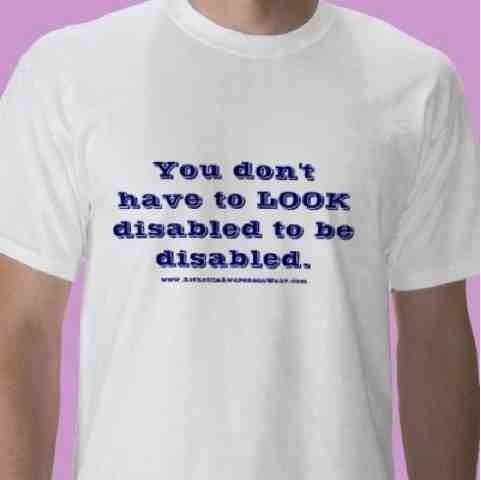
The moral all of this I think is that disability, whether it is obvious or hidden, should be equally respected and understood and likewise the person that has it. If people are not willing to understand the disability (ies) and accept the person that has them,  then they should not make comments in the first place.
I found this picture of a person wearing a T-shirt and think the message is simple but effective.   
Thank you for reading this blog post which I hope you find an informative and interesting insight into hidden disabilities , and my personal experience of them . If anything is to be learnt from all this, it's that  the moral is to not judge disabled people in the first place. 
I hope that in the future, society will accept disabled people better whether their disability is 
Invisible / hidden or not.